
LITTLE SUPERSTARS: SCHWALBE KIDS TIRES
With our kids' tires you equip your children's bikes with safe and robust tires. We offer the right tire for every purpose.
All Kids' Tires


Understanding tire sizes
The right tire size affects safety, riding comfort, and control — especially for children. A tire that is too large or too small alters the handling: braking, steering, and stability can all suffer, increasing the risk of accidents. The correct size also ensures that the child sits comfortably in the saddle and can safely reach the pedals and the ground; this builds confidence and makes learning to ride a bike a rewarding experience more quickly. In short: the right tires = better handling, fewer falls, and more fun for your child.
20-inch tires
20-inch tires are popular with children because they are both agile and smooth-rolling. They typically fit children aged around 6–10 years — more important than age is that the child can safely reach the ground with both feet. For city riding and the school run, narrower tires are sufficient; for playgrounds or light trails, wider tires with more grip are the better choice. Wider tires offer more comfort and stability, while narrower ones are faster on smooth surfaces. Tip: measure your child's inseam and think about where they'll be riding — then the 20-inch tire will be a reliable fit.

How to find the right tire
The best place to start is by asking yourself: where do I like to ride most, and on which routes will my child be joining me? If the answer is: mostly on paved roads and forest tracks, then take a look in the Urban Allround section. Here you'll find a great selection of touring and gravel tires for kids. If you're more of a mountain biker and your child is too, you'll find the right tire in the Offroad section. For very young children, Indoor tires are usually the best choice.


Our Kids Tire Highlights
Kids Empfehlung

SAY HI TO BILLY BONKERS!SCHWALBE’S NEW TIRE FOR PUMPTRACK, DIRTJUMP AND SLOPESTYLE.This lightweight (490g Performance Line), not only rolls extremely easily, it also ensures fun loving and agile riding. If tricks and jumps get messed up, Billy Bonkers remains good natured, forgiving even egregious mistakes. Maximal micro teeth for grip on dusty and sandy ground.Closely positioned blocks multiply the grippy edges.Small ramps increase the speed of the tire. The result: More Airtime! More information:News - Billy Bonkers

Just in time for the 25th anniversary of the world’s first Balloonbike tire, it is ready: Schwalbe’s Motion Big Apple – a tire that sets a statement thanks to modern design and the highest standards in environmental friendliness. It is the direct successor to the Big Ben and the predecessor model of the Big Apple.The environmental friendliness of the tire:- Addix Green: Schwalbe’s most environmentally friendly rubber compound with consistent performance, containing 80% renewable raw materials and recycled materials:- Among other things, it uses 100% recycled carbon black (recovered Carbon Black, rCB) from Schwalbe’s tire recycling.- Made 100% from fair-trade natural rubber.Comfort and cushioningThe Schwalbe Motion Big Apple absorbs every unevenness with low air pressure and rolls easily over asphalt, but also over forest paths. It stands for absolute comfort and cushions every bump thanks to its large volume – all without complicated suspension technology. The versatile tread design incorporates modern design elements, which are also reflected in the sidewall structure of the Motion Big Apple. Intended useThe Motion Big Apple is suitable for e-bikes in the touring and urban segments, but also for trekking and city bikes without motors. For everyday commuting as well as classic bike tours. The Big Apple is also a good choice for children’s and youth bikes as well as light non-motorised cargo bikes.New Motion product familyThe Motion Big Apple is also the first touring tire to be classified in Schwalbe’s new range structure. Motion represents a new product family in Schwalbe’s city/touring segment – complementing the well-known Marathon family. Further tires from the Motion family will be introduced in 2026.
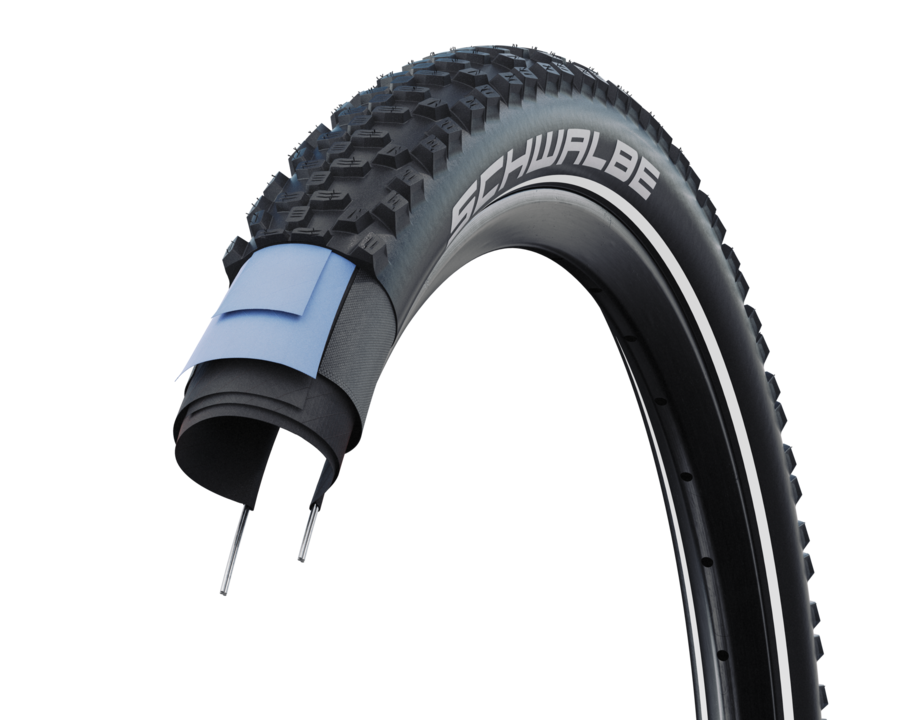
ONE FOR ALL. An impressive, perennial favorite with excellent all-round properties. For MTB riders who frequently switch between road and offroad terrain.The modern, distinctive off-road tread design stands out due to the dense center lugs, which provides comfortable rolling with low vibration and long durability.Edged outer blocks simultaneously provide safety and optimum off-road grip.
Further recommendations

BIG BETTY IS BACK! Equipped with everything modern tire technology has to offer. A Downhill and Enduro Allrounder for dry to damp conditions. Big Betty works perfectly on the rear wheel when combined with our much-loved Magic Mary.Long supported braking edges for maximum braking tractionExtremely stable shoulder blocks for outstanding cornering gripOpen and aggressive tread for excellent grip and self-cleaningOur rear-wheel specialist, Big Betty, will be discontinued from April 2026. For the time being, only the 20-inch and 24-inch children’s bike sizes will remain available. As alternatives, we recommend the Tacky Chan and Albert models.

The pioneer in puncture protection, mileage and environmental friendliness- Very good puncture protection thanks to GreenGuard- Most environmentally friendly bicycle tire:- Produced with 100% Fair Rubber- Consists of 80% recycled or renewable materials:- Among other things, the first and only tire with carbon black from recycled bicycle tires (rCB)- 99% pollution-free- Modern and sporty tread design- Recommended for bikes and e-bikes

FOR DAREDEVILS. Little Joe is made for kids. The tread fits a mountain bike and still rolls well on the road. Little Joe is light. As a folding tire it really saves weight on the bike. Most of all in size 37-406. Little Joe is safe. The K-Guard and the 50 EPI carcass protect against punctures.

The Schwalbe Motion Road Cruiser is our most environmentally friendly tire for urban use, available in different colorsA dynamic and environmentally friendly urban tireThe Schwalbe Motion Road Cruiser is our entry-level tire for urban bikes. Its smooth-rolling tread makes getting around town a breeze. The highlight of the Motion Road Cruiser is its environmentally friendly compound: Our Green compound is made exclusively from renewable and recycled raw materials and is used in the black running surface of all Road Cruisers.We offer the Schwalbe Motion Road Cruiser in several color varieties so you can find the exact tire to suit your bike. The understated tread pattern blends seamlessly into the overall look of your city bike, ensuring a clean appearance day in and day out.E-bike readyThe Schwalbe Motion Land Cruiser Plus is also approved for e-bikes with pedal assistance up to 25km/h. This is because the tire remains stable even at higher speeds and with additional weight, ensuring a safe driving experience.Lower rolling resistanceThe tread of the Motion Road Cruiser is specifically designed for low rolling resistance. In the center, an almost continuous tread ensures exceptionally fast roll-off. On the sides, micro-tread improves the grip, above all around wet corners.Our environmentally friendly Green CompoundThe Motion Road Cruiser Plus models with black running surface uses our Green Compound for the running surface compound. It improves performance and durability of the tire and is especially environmentally friendly. The Green Compound is our most sustainable compound made from polymers which exclusively consist of renewable and recycled raw materials.Correct tire pressureTo ensure your tires hold their air and you can ride smoothly, you should choose the correct tire pressure—and check it regularly. A precise manometer on the pump will help. The air pressure affects how comfortably and easily your bike rolls. You’ll find a recommended maximum and minimum on the tire – the optimum tire pressure lies between these.

LIFT OFF! The cross-country rocket combines speed and cornering control at the highest possible level. An excellent all-rounder for racetracks.Cleverly designed tread balanced for low rolling resistance whilst remaining grippy.Sufficient gaps for amazing self-cleaning properties.Stable shoulder studs.More information:ADDIX Compound
Tire pressure & puncture protection
Adequate air pressure is what allows the tire to support the weight of the bike. On the road, the rule is: the higher the pressure, the lower the rolling resistance. Puncture resistance is also better at higher pressure. Consistently low tire pressure often leads to premature tire wear — cracking of the sidewall is the typical result, and tread wear is also unnecessarily high.
On the other hand, a tire at lower pressure can absorb road impacts more effectively. Wide tires are generally run at lower pressure. They offer the opportunity to take advantage of lower pressure without significant drawbacks in terms of rolling resistance, puncture protection, or wear. Tubeless tires can also generally be ridden at a slightly lower pressure.
The right tire pressure
Tire pressure affects how safely and comfortably a kids' bike rides — too little pressure makes steering sluggish and increases the risk of punctures, while too much takes away the tire's grip. Three rules of thumb for everyday use:
Offroad
Keep the pressure on the softer side — better cushioning and more traction on gravel or forest floors.
Urban & Asphalt
Go for higher pressure — less rolling resistance and more consistent handling.
Young children
Generally stick to the lower end of the pressure range — less body weight means less counter-pressure is needed.
Always check the exact pressure specifications on the tire sidewall.
Puncture protection in kids' everyday riding
On the way to school, broken glass, sharp gravel edges, and curbs are lurking — classic causes of punctures in children's daily riding. Tires with integrated puncture protection feature an additional protective layer beneath the tread that makes it harder for sharp objects to penetrate. This is especially worthwhile for children who ride longer distances every day or spend a lot of time in urban environments. Those who ride occasionally in the park or around the yard can often manage without — the puncture risk there is simply lower.