

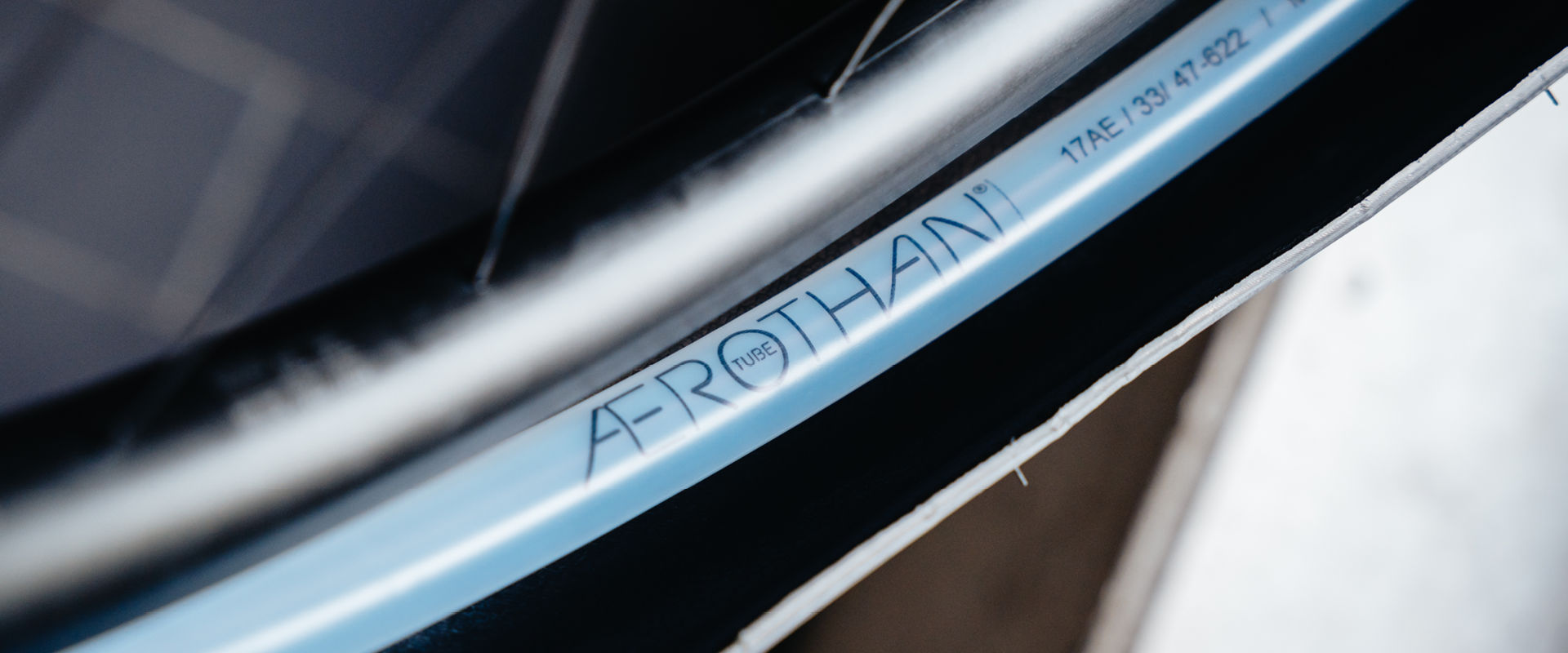


Aerothan is a special thermoplastic polyurethane which Schwalbe has developed in cooperation with BASF. It serves as base material for high end bicycle tubes, Aerothan tubes, which are made in Germany using a patented welding process.
Aerothan is a material that completely redefines bicycle tubes: extremely light, with maximum puncture protection and designed for minimum rolling resistance.
Schwalbe presents the new generation of its Aerothan inner tubes. The extremely light and robust tubes are now equipped with an aluminum shaft and an external thread (previously: plastic). This not only provides additional stability and improved handling, but also offers various compatibility benefits.
At the same time, the Aerothan inner tube impresses with its key performance benefits: Minimal weight, very low rolling resistance and a high level of robustness. In all six specialist magazine tests in which it has taken part, it has been named test winner - most recently in Bike (01/2025) and Mountainbike (9/2024). The new Aerothan tubes will continue to be produced at the Schwalbe headquarters in Reichshof, North Rhine-Westphalia, and will be available from fall 2025. The selection ranges from small to large: Schwalbe offers a total of 39 different articles.
What's new?
- High robustness
- Very low rolling resistance
- Tubeless-level performance

40 % lighter
Aerothan Tubes are about 40% lighter than a comparable Schwalbe Extralight tube made of butyl.
New aluminum valve stem
Increased puncture protection
Extremly low rolling resistance
40 % lighter
Aerothan Tubes are about 40% lighter than a comparable Schwalbe Extralight tube made of butyl.
New aluminum valve stem
Increased puncture protection
Extremly low rolling resistance
AEROTHAN TUBE - THE FACTS
Aerothan Tubes are about 40% lighter than a comparable Schwalbe Extralight tube made of butyl.
Aerothane Tubes have an extremely low rolling resistance at tubeless level.
Aerothane Tubes offer increased puncture protection. The high puncture protection prevents sudden air loss.
The Aerothan Tube features an aluminum valve stem with an external thread (previously: plastic). The sturdy construction makes it easier to handle in everyday use and ensures a secure connection when inflating.
Contribution to the circular economy
From an environmental perspective, the Aerothan tube also sets new standards.
Together with partner companies, Schwalbe ensures that used tires are recycled and the raw materials recovered from them are reintroduced into the production of the new Aerothan tube. As a result, the proportion of circular materials in the Aerothan tube is around 91 percent, while maintaining consistently high quality and durability.
The TPU used is partially based on raw materials from the chemical recycling of used tires. This helps conserve fossil resources, and the tube makes an important contribution to the circular economy.

Sign up for the newsletter
The Schwalbe newsletter keeps you up to date on current promotions and new products. Sign up now for free and get valuable information straight to your e-mail inbox. So you are always well informed!

Development
In the development of Aerothan Tubes Schwalbe has gone new ways from the beginning. The result is a high-end alternative to conventional bicycle tubes. Schwalbe wants to offer the optimum product for every cyclist. When it comes to high-end bicycle inner tubes, this becomes an exciting challenge. The engineers have to reconcile the apparent opposites of lowest weight and highest puncture resistance. A case for the Schwalbe Innovation Lab, where material compositions and design principles are redeveloped to create unprecedented products. This is how the Aerothan Tube was created, which not only meets but exceeds the expectations of a high-end bicycle tube.
The Aerothan Tube range
The new Aerothan tube is available in different sizes and with different valves to ensure you have the ideal tube for your application. you have the ideal tube for your application. The Aerothan tubes are also available in the “Plus” version with increased thickness and even higher puncture protection.

Aerothan vs. Butyl: The Difference

PLUNGER TEST
During the so-called plunger test, a plunger with a round tip (1 mm diameter) is forced into the tube at increasing pressures until it can no longer sustain the pressure. The Aerothan tube is superior to all other tubes when tested at a force of 47 N, and its stretching capacity of 18 mm was the same as the test result of a latex tube.

SNAKE BITE TEST (ROAD)
During the snake bite test, a guillotine is dropped onto the tire from increasing heights until the tube releases air due to a snake bite. The Aerothan tube sustains greater drop heights than latex or plastic tubes, and therefore, offers much greater protection from pinch flats.

SNAKE BITE TEST (MTB)
During the mountain bike specific snake bite test, a guillotine with a round edge is dropped onto the tire in order to simulate impacts from roots and stones. At the same time, the drop height is increased until the tire releases air due to a snake bite. The Aerothan tube is comparable to tubeless systems, and during MTB specific testing, it shows significantly greater protection from pinch flats than the X-Light butyl tube

WEIGHT
The given weight is an average value derived from ten tubes each per model which were weighed. The Aerothan tube saves more than 50 g in weight compared to Schwalbe Extralight, and on top of that, it offers much better puncture protection.

ROLLING RESISTANCE
During the rolling resistance test, the tire rolls at a speed of 40 km/h. The output required to maintain this speed is measured.
Here, the rolling resistance of the Aerothan tube is about the same as the latex tube. However, with much less weight. Gewicht

DYNAMIC HEAT RESISTANCE
During the heat resistance test, a starting temperature of 30°C is chosen and the test is carried out at a speed of 78 km/h and a 30% brake force. Additionally, the number of emergency brake applications the tube resists is recorded.
The dynamic test winner is the Aerothan Tube; and this is the only tube that can withstand a sequence of seven emergency brake applications. All Aerothan tubes are approved for use with rim brakes.
Good to know: Aerothan tubes do not suddenly burst. Any air loss occurs slowly as a worst case, while the bicycle normally remains easy to control.
Tube Size Compatibility Based on Tire Width and Rim Inner Width
Depending on their width, tires are approved for a specific range of rim inner widths according to DIN EN ISO and ETRTO. As a result, the rider has limited options when choosing which rim to pair with their tire.
As the rim’s inner rim width increases, the actual width of the tire increases. The actual tire volume therefore also increases, which is why inner tubes, due to their approved dimensional specifications, cannot cover every tire-rim combination approved by ETRTO.
For example, it is possible that a 32mm-wide tire is approved for a rim with a 25mm inner rim width, but the actual width of the mounted tire is not 32mm, but 33mm. In this case, you must switch to the next larger size with an approval starting at a tire width of 33mm
The following table provides information on which tire-rim width combination requires you to switch to the next larger tube.
| Tube | Size | theoretically allowed rim-width (ref. ETRTO) | not compatible tire/rim combo | compatible item | size of compatible item |
|---|---|---|---|---|---|
| SV4AE | 33/47-349 | 16-30mm | 47mm tire >28mm inner-rim-width | no Aerothan tube option | - |
| SV5-AE | 33/47-406 | 16-30mm | 47mm tire >28mm inner-rim-width | SV6AE | 47/65-406 |
| SV7AE | 23/32-451 | 15-25mm | 30mm tire >23mm inner-rim-width | no Aerothan tube option | - |
| SCV15AE/SV15AE | 23/32-622 | 15-25mm | 30mm tire >23mm inner--rim-width | SCV17AE/SV17AE | 33/47-622 |
| SCV17AE/SV17AE | 33/47-622 | 16-30mm | 47mm tire >28mm inner-rim-width | SCV19AE/SV19AE | 47/65-622 |
faq
GENERAL
Aerothan tubes are extremely light, yet highly puncture resistant. The low rolling resistance offers an extremely dynamic riding experience. Aerothan retains its shape and ensures stable riding characteristics on all bicycles, even at low air pressures. At the same time, its dimensional stability makes it easy to install because the tube does not slide around and cannot get pinched.
Schwalbe is the expert for tubeless tires. However, some cyclists prefer using a tube despite tubeless as the state-of-the-art option. Additionally, certain wheel types are not suitable for tubeless. Therefore, we have developed Aerothan tubes – the high-end alternative to conventional bicycle tubes. Many of its technical advantages achieve the same high standards that tubeless systems do.
Aerothan tubes are available for all common tire sizes for: Road, Allround and MTB. You can find an overview with all sizes here.
Aerothan tubes are available in the categories Road, Allround and MTB, where Aerothan has extremely diverse areas of application due to its particular material characteristics. You can find an overview with all sizes here.
Aerothan is a flexible material and is subject to limited tolerances (as opposed to solids such as metal). Despite highly elaborate manufacturing and control procedures, deviations in weight of +/- 5% may occur.
Aerothan is extremely temperature stable. The material can withstand both high temperatures of up to +70°C and low temperatures of down to -50°C without any problems.
WARTUNG & REPARATUR
You can easily repair Aerothan tubes using Schwalbe Glueless Patches Roughening, as with a butyl tube, is not necessary. Instead, the self-adhesive patches are directly placed on the area to be fixed. To do so, the surface should be as clean as possible.
For larger holes or cuts (max. 4 mm), it is recommended to use two patches overlapping over the defective area. It is helpful to clean the defective area with cleaning alcohol in advance to improve the adhesion (adhesive strength) of the patch.
Can I use classic tube patches with vulcanizing fluid to repair a puncture?.
Repair and inflate sealant sprays do not seal Aerothan Tubes because the thermoplastic polyurethane (TPU) has a very high surface tension. The use of puncture sprays in tubes made of TPU is not recommended due to the chemical composition. For optimal performance, Aerothan Tubes should be used without puncture sprays. Continuous use with puncture sprays is not recommended.
VALVE
The Aerothan Tube has a 40mm long Sclaverand (SV/Presta) valve. Just like the tube, the valve stem is made of thermoplastic polyurethane and is also 100% recyclable. Certain Aerothan tube sizes are also available with longer 60mm or 80mm valve lengths.
"The valve core of the Aerothan Tube is screwed in and can be replaced if necessary. This also makes the valve stem suitable for extensions.
Tip: Extensions should ideally be fitted with a thread locking compound (LOCTITE® 222 Purple Threadlocker). Schwalbe (tubeless) valve extensions are ideally suited for Aerothan Tubes (https://www.schwalbe.com/en/TUBELESS-VALVE-EXTENSION-3461). Only extensions that are screwed into the Aerothan valve stem and have a screw-in limit should be used.
No. Valve cores for Aerothan Tubes have a special rubber seal. For Schwalbe butyl tubes, valve cores with a Teflon seal are used. The mechanical and thermal properties of rubber harmonize much better with the material TPU. This guarantees an optimal seal with the TPU valve stem.
The valve stem diameter of the Aerothan Tubes is matched to the standard diameter of a (SV/Presta) Sclaverand valve hole in a rim. When the valve core is screwed in, the valve stem expands slightly. This can prevent the valve stem fitting through the rim valve hole. In this case, the valve core should be unscrewed. Then insert the valve stem through the valve hole in the rim and screw in the valve core again. Under no circumstances should the valve stem be machined. This carries the risk of defects.
An AV valve hole has a diameter of approx. 8.5 mm. The SV valve of the Aerothan Tube has a diameter of approx. 6.1 mm. This difference can lead to noise while riding and puts above-average strain on the material. In this case, a reducing sleeve should be used, which is pushed over the valve stem of the Aerothan Tube and held in the valve hole by the valve. Reducing sleeves or valve hole adapters are not available from Schwalbe.
An AV adapter can be used. For a secure fit, it must be screwed approx. 3-4 turns onto the external thread of the valve insert.
The valve base is conically shaped towards the tube. It serves as a support for the valve stem, thus counteracting strong mechanical effects, such as shear forces. During assembly, the cone can rest on the rim well and retracts slightly into the valve hole as the air pressure increases. This ensures that the valve stem is held securely in the valve hole. The valve base is made of the same material as the tube, so that the tube and valve base expand evenly.
INSTALLATION & SERVICING
Aerothan tubes are installed just like any other bicycle tube. Thanks to the dimensional stability of the material, the tube does not shift easily and does not get pinched, which allows for much more straightforward installation. However, outside the tire, Aerothan tubes may only be inflated up to max. 0.3 bar.
The transparent Aerothan material changes colour when in contact with the compounds of the tread. This is due to diffusion of volatile substances which are released as a result of the vulcanization process. This occurs especially with new, unused tires. The change in colour has no impact on performance or durability of the tubes.
If a sealant is no longer able to seal the tire while you are on the road, you can of course use the Aerothan Tube as a first aid measure, even without completely removing the sealant from the tire. Afterwards, the tube should be cleaned as quickly and thoroughly as possible with water and a cloth or cleaning alcohol. Under no circumstances should chemicals be used to clean the tube. The tire should be replaced depending on the size of the defect.
An Aerothan tube may be inflated carefully outside the tire until it has no more folds and is round in shape (equivalent to max. 0.3 bar).
Yes, however, a CO2 cartridge should only be used once the tube has been fully installed. Outside the tire, Aerothan tubes may only be inflated carefully until they reach a round shape and are free of folds (equivalent to max. 0.3 bar); CO2 cartridges are not intended for this purpose.
Yes, however, an Aerothan tube may only be reinstalled into a tire of the same or of greater width.
Sealing liquid does not achieve any sealing effect with Aerothan tubes because the surface tension of thermoplastic polyurethane (TPU) is very high. Using latex based sealing liquid for tubes made of TPU is not recommended due to the chemical composition. For optimal performance, Aerothan tubes should only be used in tires without sealing liquid. Long-term use with sealing liquid is not recommended.
Repair sprays do not achieve any sealing effect with Aerothan tubes because the surface tension of thermoplastic polyurethane (TPU) is very high. Using repair spray for tubes made of TPU is not recommended due to the chemical composition. For optimal performance, Aerothan tubes should only be used without repair spray. Long-term use with repair spray is not recommended.
If a sealant is no longer able to seal the tire while you are on the road, you can of course use the Aerothan Tube as a first aid measure, even without completely removing the sealant from the tire. Afterwards, the tube should be cleaned as quickly and thoroughly as possible with water and a cloth or cleaning alcohol. Under no circumstances should chemicals be used to clean the tube. The tire should be replaced depending on the size of the defect.
Talcum is not harmful to the AEROTHAN Tube. However, it is not necessary to use it, as the AEROTHAN Tube is provided with a special lubricant during production. In addition, the friction between the TPU material of the tube and the rubber carcass of the tire is extremely low.
All Aerothan tubes are approved for rim brakes. Aerothan tubes are extremely resistant to heat and can sustain high thermal stress (for example during emergency braking). Also, in case of a defect, air does not suddenly escape, which is why riding stability remains unaffected.
All Aerothan Tubes are suitable for use with carbon rims. Here, too, the heat resistance of Aerothan material is an advantage over latex and butyl.
Tyre pressure sensors can be mounted if they are screw-in systems. These are then screwed onto the visible external thread of the valve core. Please check compatibility with the respective supplier.
"Rim tape, when used correctly, always provides additional protection against defects. The Aerothan Tube is generally compatible with all common rim tapes. It is best used with Schwalbe Tubeless Rim Tape (https://www.schwalbe.com/en/TUBELESS-RIM-TAPE-887029). Always make sure that the width of the rim tape matches that of the rim. If the rim tape does not lie neatly from flank to flank in the rim bed, it can come into contact with the tube. See also: https://www.schwalbe.com/en/technology-faq/rim-tape/
Mini pumps with screw-on pump heads (e.g. from Lezyne) can be used. To do this, the valve core of the Aerothan Tubes must be firmly seated in the valve stem (see above reference thread locking compound). The pump head should be screwed onto and off the valve core with as little tension as possible. Ideally, the valve stem should be held in place while screwing and unscrewing the pump head, so that only the thread of the pump head is moved.
TIRE PRESSURE
"Thanks to their enormous shape stability, Aerothan Tubes can be used at significantly lower air pressures than conventional bicycle tubes. The recommendations for tubeless systems can be used as a guide for the correct air pressure. It should be noted that the minimum pressure engraved on Schwalbe tires is for use with butyl tubes. When using Aerothan Tubes, the values may be lower. The Schwalbe MTB Pressure Prof can be used to quickly and easily calculate the optimum air pressure in the tire online:"
At the maximum pressure for Aerothan Tubes, the pressure range indicated on the tire side or rim should be observed. If the specified tire pressure of the rim is lower than that of the tire, the maximum pressure of the rim must be observed. If in doubt, contact the manufacturer.
Aerothan tubes are on a par with butyl tubes in terms of how well they retain air. Frequent re-inflation, as is necessary with latex tubes, for example, is therefore not necessary. For optimal performance, it is recommended that the air pressure be checked regularly.
The Aerothan Tube can be left in the tire without concern. It is recommended that the tire pressure be slightly reduced by one to two bar below the maximum permissible air pressure of the tire or rim (whichever is the lower). Information on tire pressure can be found on the side walls of bicycle tires. Find out more at: https://www.schwalbe.com/technik-faq/spezielles/https://www.schwalbe.com/en/technology-faq/special/
